
Beis Hamikdash 3D
Explore the spaces. Understand the service.
baishamikdash3d.comHobby & exploration
The problem
Understanding the Beis Hamikdash involves more than looking around a building. The location of a vessel, its construction and the order of a service all affect how a learner understands the same scene. Sources and variants also leave decisions that a convincing 3D model can accidentally make look definitive.
Detailed geometry adds another constraint: reading a guide should not require loading an entire 3D environment, and a phone should not keep rendering an unseen model.
The solution
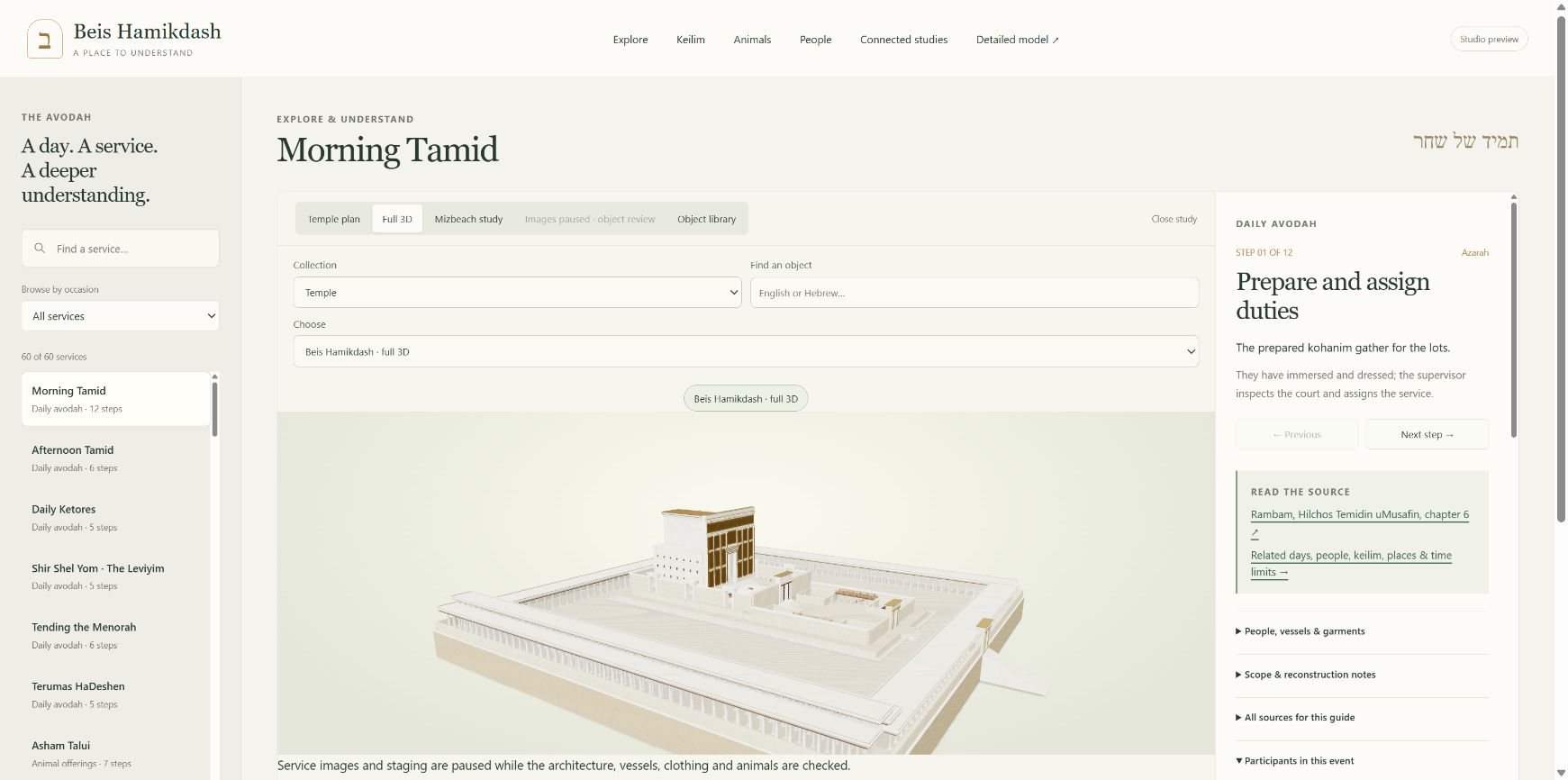
The project builds on an existing reference viewer with source-linked service guides and an independent study studio. Plans, object studies and staged views connect the written sequence to the relevant space or implement. Reconstruction notes distinguish the selected explanation from unresolved details and simplified geometry.
The studio separates reading from rendering, loads individual models when needed and stops drawing settled or hidden views. Object review remains ongoing; this is a developing educational reconstruction rather than a completed simulation.
The decisions behind it
- Sources alongside the scene
- A model supports learning, while source references, variants and reconstruction notes preserve the distinction between evidence and illustration.
- Read first, load 3D when needed
- Guides and plans remain accessible independently of the heavier renderer, with individual object loading and an explicit rendering lifecycle.
- Source-linked service guides
- Interactive plans and 3D object studies
- Selective model loading and review notes