
Clocker
From time on site to time in the books.

Automation
The problem
A timer is only the first step. Hours recorded on a building site must survive a lost connection, reach the correct Zoho Books organisation and remain consistent when a phone retries an upload. Once those hours have been billed, an edit must not quietly rewrite the basis of the invoice.
The same workflow also has to distinguish workers from project managers and handle expenses paid personally without counting the business cost twice.
The solution
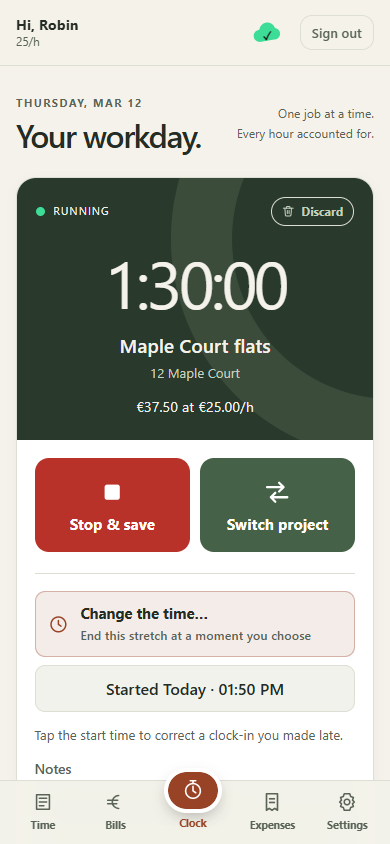
Clocker records time on the device first, then synchronises using stable entry identifiers so repeated uploads refer to the same record. The app makes pending work visible and locks billed entries on both the screen and the server.
Project-based permissions connect field work to Zoho Books. Expense capture records the job and who paid; personal payments can flow into the worker's next bill with accounting treatment that avoids duplicating the expense. Workers can see their hours, bills and payments in one place.
The decisions behind it
- Record now, synchronise later
- Saving time cannot depend on mobile signal. Local persistence and repeatable uploads address different failure points in the same workflow.
- An invoice changes the rules
- An unbilled entry can be corrected. A billed entry is locked because it is now part of a financial record.
- Reimbursement without double counting
- Who paid for a receipt affects how the worker is repaid, while the underlying business expense should still be counted once.
- Mobile time entry that works offline
- Company-specific Zoho Books connections
- Worker access to time, bills and payments